Wednesday, April 10, 2013

Indian Famous Authors

                                                        APJ Abdul Kalam


Avul Pakir Jainulabdeen Abdul Kalam (born 15 October 1931) usually referred to asDr. A. P. J. Abdul Kalam, is an Indian scientist and administrator who served as the 11thPresident of India from 2002 to 2007. Kalam was born and raised in RameswaramTamil Nadu, studied physics at the St. Joseph's College, Tiruchirappalli, and aerospace engineering at the Madras Institute of Technology (MIT), Chennai.
Before his term as President, he worked as an aerospace engineer with Defence Research and Development Organisation (DRDO) and Indian Space Research Organisation(ISRO).Kalam is popularly known as the Missile Man of India for his work on the development of ballistic missile and launch vehicle technology. He played a pivotal organizational, technical and political role in India's Pokhran-II nuclear tests in 1998, the first since the original nuclear test by India in 1974. Some scientific experts have however called Kalam a man with no authority over nuclear physics but who just carried on the works of Homi J. Bhabha and Vikram Sarabhai.

Some scientific experts have however called Kalam a man with no authority over nuclear physics but who just carried on the works of Homi J. Bhabha and Vikram Sarabhai.
Kalam was elected the President of India in 2002, defeating Lakshmi Sahgal and was supported by both the Indian National Congress and the Bharatiya Janata Party, the major political parties of India. He is currently a visiting professor at Indian Institute of Management Ahmedabad and Indian Institute of Management IndoreChancellor of theIndian Institute of Space Science and Technology Thiruvananthapuram, a professor of Aerospace Engineering at Anna University (Chennai), JSS University (Mysore) and an adjunct/visiting faculty at many other academic and research institutions across India.
Kalam advocated plans to develop India into a developed nation by 2020 in his book India 2020. Books authored by him have received considerable demands in South Korea for the translated versions. He has received several prestigious awards, including the Bharat Ratna, India's highest civilian honour. Kalam is known for his motivational speeches and interaction with the student community in India. He launched his mission for the youth of the nation in 2011 called the What Can I Give Movement with a central theme to defeatcorruption in India.

A. P. J. Abdul Kalam was born on 15 October 1931 in a Tamil Muslim family to Jainulabdeen, a boat owner and Ashiamma, a housewife, at Rameswaram, located in the South Indian state of Tamil Nadu.He came from a poor background and started working at an early age to supplement his family's income. After completing school, Kalam distributed newspapers in order to financially contribute to his father's income. In his school years, he had average grades, but was described as a bright and hardworking student who had a strong desire to learn and spend hours on his studies, especially mathematics.
"I inherited honesty and self-discipline from my father; from my mother, I inherited faith in goodness and deep kindness as did my three brothers and sisters."
—A quote from Kalam's autobiography
.Towards the end of the course, he was not enthusiastic about the subject and would later regret the four years he studied it. He then moved to Madras in 1955 to study aerospace engineering. While Kalam was working on a senior class project, the Dean was dissatisfied with the lack of progress and threatened revoking his scholarship unless the project was finished within the next two days. He worked tirelessly on his project and met the deadline, impressing the Dean who later said, "I [Dean] was putting you [Kalam] under stress and asking you to meet a difficult deadline".

After graduating from Madras Institute of Technology (MIT – Chennai) in 1960, Kalam joined Aeronautical Development Establishment of Defense Research and Development Organization (DRDO) as a scientist. Kalam started his career by designing a small helicopter for the Indian Army, but remained unconvinced with the choice of his job at DRDO. Kalam was also part of the INCOSPAR committee working under Vikram Sarabhai, the renowned space scientist. In 1969, Kalam was transferred to the Indian Space Research Organization (ISRO)where he was the project director of India's first indigenous Satellite Launch Vehicle (SLV-III) which successfully deployed the Rohini satellite in near earth orbit in July 1980. Joining ISRO was one of Kalam's biggest achievements in life and he is said to have found himself when he started to work on the SLV project. Kalam first started work on an expandable rocket project independently at DRDO in 1965.In 1969, Kalam received the government's approval and expanded the program to include more engineers.

Kalam served as the 11th President of India, succeeding K. R. Narayanan. He won the 2002 presidential election with an electoral vote of 922,884, surpassing 107,366 votes won by Lakshmi Sahgal. He served from 25 July 2002 to 25 July 2007.

The controversy that surrounds Kalam's role as a nuclear scientist, is the lack of reliable and factual reporting of the yield of Pokhran-IItests.] The director of the site test, K. Santhanam, publicly admitted that the thermonuclear bomb was a "fizzle" test, criticising Kalam for issuing the wrong report. However, Kalam dismissed the claims and R. Chidambaram, a key associate of Pokhran-II, also described these claims as incorrect.


In spite of his leading role in the development of Indian nuclear programme, Kalam has received criticism from many of his peers who claimed that he had "no authority" over nuclear science.Homi Sethna, a chemical engineer criticised Kalam claiming that Kalam had no background in publishing articles in nuclear science, even in nuclear physics. Sethna maintained that Kalam received his masters degree in aerospace engineering, which is a completely different discipline from nuclear engineering, and what various universities awarded him for his achievements had nothing to do with nuclear physics. Sethna, in his last interview, maintained that in the 1950s, Kalam had failed advanced physics courses during his college life and quoted "What does he know (about [nuclear] physics)....?", on the national television. Homi Sethna also accused Kalam of using his presidency to gain a national stature of a nuclear scientist.

Kalam was frisked at the JFK Airport in New York, while boarding a plane on 29 September 2011. He was subjected to "private screening" as he does not come under the category of dignitaries exempt from security screening procedures under American guidelines. He was frisked again after boarding the Air India aircraft with the US security officials asking for his jacket and shoes, claiming that these items were not checked according to the prescribed procedures during the "private screening", despite protests from the airline crew confirming him as India's president.
In his book India 2020, Kalam strongly advocates an action plan to develop India into a knowledge superpower and a developed nation by the year 2020. He regards his work on India's nuclear weapons program as a way to assert India's place as a future superpower.
It was reported that, there was a considerable demand in South Korea for translated versions of books authored by him.

In May 2011, Kalam launched his mission for the youth of the nation called the What Can I Give Movement with a central theme to defeat corruption. He also has interests in writing Tamil poetry and in playing veenai, a South Indian string instrument.
A. P. J. Abdul Kalam's 79th birthday was recognised as World Students' Day by United Nations.[86] He has also received honorary doctorates from 40 universities.[87][88] The Government of India has honoured him with the Padma Bhushan in 1981 and the Padma Vibhushan in 1990 for his work with ISRO and DRDO and his role as a scientific advisor to the Government.[89] In 1997, Kalam received India's highest civilian honour, the Bharat Ratna, for his immense and valuable contribution to the scientific research and modernisation of defence technology in India.[90]
Year of award or honourName of award or honourAwarding organisation
2012Doctor of Laws (Honoris Causa)Simon Fraser University[91]
2011IEEE Honorary MembershipIEEE[92]
 etc
                               Biographies
  • Eternal Quest: Life and Times of Dr. Kalam by S. Chandra; Pentagon Publishers, 2002.
  • President A. P. J. Abdul Kalam by R. K. Pruthi; Anmol Publications, 2002.etc 


                Books and documentaries


AbdulKalam.JPG
Abdul Kalam at the 12th Wharton India Economic Forum, 2008
11th President of India
In office
25 July 2002 – 25 July 2007
Prime MinisterAtal Bihari Vajpayee
Manmohan Singh
Vice PresidentBhairon Singh Shekhawat
Preceded byK. R. Narayanan
Succeeded byPratibha Devisingh Patil
Personal details
Born15 October 1931 (age 81)
RameswaramIndia (present day Tamil Nadu, India)
Alma materSt. Joseph's College, Tiruchirappalli
Madras Institute of Technology
ProfessionProfessor, Author, scientist
Aerospace engineer
Websiteabdulkalam.com


Indian Famous Artist

                                                                   Indian  Famous  Artists
                                                                                S.H. Raza


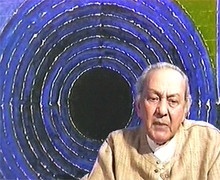
Syed Haider Raza Alias S.H. Raza (born 22 February 1922) is an Indian artist who has lived and worked in France since 1950, but maintains strong ties with India.
His works are mainly abstracts in oil or acrylic, with a very rich use of color, replete with icons from Indian cosmology as well as its philosophy. He was awarded the Padma Shri and Fellowship of the Lalit Kala Akademi[ in 1981, Padma Bhushan in 2007, andPadma Vibhushan in 2013.
He became India's priciest modern artist on June 10, 2010 when a seminal work, 'Saurashtra' by the 88-year-old sold for INR 16.42 crore ($3,486,965) at a Christie's auction.
Biography

[edit]Early life and education

Syed Haider Raza was born in Babaria, Mandla districtMadhya Pradesh, to Sayed Mohammed Razi, the Deputy Forest Ranger of the district and Tahira Begum, and it was here that he spent his early years and took to drawing at age 12; before moving toDamoh also in Madhya Pradesh at 13,where he completed his school education from Government High School, Damoh.
After his high school, he studied further at the Nagpur School of Art, Nagpur (1939–43), followed by Sir J. J. School of ArtBombay(1943–47), before moving to France in October 1950 to study at the École nationale supérieure des Beaux-Arts (ENSB-A) in Paris, 1950-1953 on a Govt. of France scholarship. After his studies, he travelled across Europe, and continued to live and exhibit his work in Paris. He was later awarded the Prix de la critique in Paris in 1956, becoming the first non-French artist to receive the honour.mandy maan

Early career

Syed Haider Raza, has his first solo show in 1946 at Bombay Art Society Salon, and was awarded the Silver Medal of the society.
His work evolved from painting expressionistic landscapes to abstract ones. From his fluent water colours of landscapes and townscapes executed in the early 40's he moved towards a more expressive language painting landscapes of the mind.
1947 proved to be a very important year for him, at first his mother died, and this was also the year when he co-founded the revolutionary Bombay Progressive Artists' Group (PAG) (1947–1956)  along with K.H. Ara and F.N. Souza (Francis Newton Souza),which set out to break free from the influences of European realism in Indian art and bring Indian inner vision (Antar gyan) into the art,the group had its first show in 1948, the year his father died in Mandla and most of his family of four brothers and a sister migrated to Pakistan, after the partition of India.
Once in France, he continued to experiment with currents of Western Modernism moving from Expressionist modes towards greater abstraction and eventually incorporating elements of Tantrism from Indian scriptures. Whereas his fellow contemporaries dealt with more figural subjects, Raza chose to focus on landscapes in the 1940s and 50s, inspired in part by a move to the France.
In 1959, he married French artist, Janine Mongillat, and three years later, in 1962, he became a visiting lecturer at the University of California in Berkeley, USA. Raza was initially enamored of the bucolic countryside of rural France. Eglise is part of a series which captures the rolling terrain and quaint village architecture of this region. Showing a tumultuous church engulfed by an inky blue night sky, Raza uses gestural brushstrokes and a heavily impasto-ed application of paint, stylistic devices which hint at his later 1970s abstractions.


The 'Bindu' and beyond

By the 1970s Raza had grown increasingly unhappy and restless with his own work and wanted to find a new direction and deeper authenticity in his work, and move away from what he called the 'plastic art'. His trips to India, especially to caves of Ajanta - Ellora, followed by those Benaras, Gujarat and Rajasthan, made him realise his ro and study Indian culture more closely, the result was 'Bindu', which signified his rebirth as a painter.The Bindu came forth in 1980, and took his work deeper and brought in, his new-found Indian vision and Indian ethnography. One of the reasons he attributes to the origin of the 'Bindu', have been his elementary school teacher, who on finding him lacking adequate concentration, drew a dot on the blackboard and asked him to concentrate on it.


Public contributions

He has also founded 'Raza Foundation' in India, promotion of art among Indian youth, which also gives away, Annual Raza Foundation Award, to young artists.

Personal life

S. H. Raza married Janine Mongillat, his fellow student at Ecole de Beaux Arts in Paris and later became a well-known artist and sculptor. They married in 1959, and at the request of her mother not to leave France, Raza chose to remain. Janine died on April 5, 2002 in Paris.

Awards


Exhibitions

  • 2010 Flora Jansem Gallery, Raza Ceramiques, Paris
  • 2010 Akar Prakar Art Gallery,Kolkata, Ahmadabad, Jaipur INDIA in 2010 etc


Further reading


Sayed Haider Raza (1995).png

Padma Vibhushan
Syed Haider Raza

Syed Haider Raza
BornFebruary 22, 1922 (age 91)
Babaria, Central Provinces and Berar
British India
NationalityIndian
FieldPainter
AwardsPadma Vibhushan 2013
Padma Bhushan 2007
Fellow, Lalit Kala Akademi 1981


Sunday, April 7, 2013

                                                                   Indian  Famous  Artists
                                                                                S.H. Raza


Syed Haider Raza Alias S.H. Raza (born 22 February 1922) is an Indian artist who has lived and worked in France since 1950, but maintains strong ties with India.
His works are mainly abstracts in oil or acrylic, with a very rich use of color, replete with icons from Indian cosmology as well as its philosophy. He was awarded the Padma Shri and Fellowship of the Lalit Kala Akademi[ in 1981, Padma Bhushan in 2007, andPadma Vibhushan in 2013.
He became India's priciest modern artist on June 10, 2010 when a seminal work, 'Saurashtra' by the 88-year-old sold for INR 16.42 crore ($3,486,965) at a Christie's auction.

Biography

[edit]Early life and education

Syed Haider Raza was born in Babaria, Mandla districtMadhya Pradesh, to Sayed Mohammed Razi, the Deputy Forest Ranger of the district and Tahira Begum, and it was here that he spent his early years and took to drawing at age 12; before moving toDamoh also in Madhya Pradesh at 13,where he completed his school education from Government High School, Damoh.
After his high school, he studied further at the Nagpur School of Art, Nagpur (1939–43), followed by Sir J. J. School of ArtBombay(1943–47), before moving to France in October 1950 to study at the École nationale supérieure des Beaux-Arts (ENSB-A) in Paris, 1950-1953 on a Govt. of France scholarship. After his studies, he travelled across Europe, and continued to live and exhibit his work in Paris. He was later awarded the Prix de la critique in Paris in 1956, becoming the first non-French artist to receive the honour.mandy maan

Early career

Syed Haider Raza, has his first solo show in 1946 at Bombay Art Society Salon, and was awarded the Silver Medal of the society.
His work evolved from painting expressionistic landscapes to abstract ones. From his fluent water colours of landscapes and townscapes executed in the early 40's he moved towards a more expressive language painting landscapes of the mind.
1947 proved to be a very important year for him, at first his mother died, and this was also the year when he co-founded the revolutionary Bombay Progressive Artists' Group (PAG) (1947–1956)  along with K.H. Ara and F.N. Souza (Francis Newton Souza),which set out to break free from the influences of European realism in Indian art and bring Indian inner vision (Antar gyan) into the art,the group had its first show in 1948, the year his father died in Mandla and most of his family of four brothers and a sister migrated to Pakistan, after the partition of India.
Once in France, he continued to experiment with currents of Western Modernism moving from Expressionist modes towards greater abstraction and eventually incorporating elements of Tantrism from Indian scriptures. Whereas his fellow contemporaries dealt with more figural subjects, Raza chose to focus on landscapes in the 1940s and 50s, inspired in part by a move to the France.
In 1959, he married French artist, Janine Mongillat, and three years later, in 1962, he became a visiting lecturer at the University of California in Berkeley, USA. Raza was initially enamored of the bucolic countryside of rural France. Eglise is part of a series which captures the rolling terrain and quaint village architecture of this region. Showing a tumultuous church engulfed by an inky blue night sky, Raza uses gestural brushstrokes and a heavily impasto-ed application of paint, stylistic devices which hint at his later 1970s abstractions.


The 'Bindu' and beyond

By the 1970s Raza had grown increasingly unhappy and restless with his own work and wanted to find a new direction and deeper authenticity in his work, and move away from what he called the 'plastic art'. His trips to India, especially to caves of Ajanta - Ellora, followed by those Benaras, Gujarat and Rajasthan, made him realise his ro and study Indian culture more closely, the result was 'Bindu', which signified his rebirth as a painter.The Bindu came forth in 1980, and took his work deeper and brought in, his new-found Indian vision and Indian ethnography. One of the reasons he attributes to the origin of the 'Bindu', have been his elementary school teacher, who on finding him lacking adequate concentration, drew a dot on the blackboard and asked him to concentrate on it.


Public contributions

He has also founded 'Raza Foundation' in India, promotion of art among Indian youth, which also gives away, Annual Raza Foundation Award, to young artists.

Personal life

S. H. Raza married Janine Mongillat, his fellow student at Ecole de Beaux Arts in Paris and later became a well-known artist and sculptor. They married in 1959, and at the request of her mother not to leave France, Raza chose to remain. Janine died on April 5, 2002 in Paris.

Awards


Exhibitions

  • 2010 Flora Jansem Gallery, Raza Ceramiques, Paris
  • 2010 Akar Prakar Art Gallery,Kolkata, Ahmadabad, Jaipur INDIA in 2010 etc


Further reading


Sayed Haider Raza (1995).png
 
Padma Vibhushan
Syed Haider Raza

Syed Haider Raza
BornFebruary 22, 1922 (age 91)
Babaria, Central Provinces and Berar
British India
NationalityIndian
FieldPainter
AwardsPadma Vibhushan 2013
Padma Bhushan 2007
Fellow, Lalit Kala Akademi 1981


Thursday, April 4, 2013

 Robin Williams

U.S. Gross – $3,177,675,199
Worldwide Gross – $5,749,935,745

006ntm_robin_williams_024

Robin Williams is a storied comedic actor who rose to fame with his role as the alien Mork in the TV series Mork and Mindy.  He quickly became an international celebrity and movie star in the 1980’s.  Williams is a bit of a goofy character, but is a great actor and can also tackle dramatic roles.  He has won six Golden Globes and three Grammy Awards in his career.  Robin William’s average film gross is $59,956,136 million dollars per movie.  Be sure to look out for his 2010 release Old Dogs.  In March of 2009 Williams had successful heart surgery to replace his aortic valve.  He has a tour planned and still travels the world performing his stand up comedy act.
Most Successful Films:
  1. Night at the Museum – $574,480,841
  2. Aladdin – $504,050,219
  3. Mrs. Doubtfire – $441,286,195
  4. Happy Feet – $385,000,317


Read more: http://www.toptenz.net/top-10-most-successful-actors-at-the-box-office.php#ixzz2PYwdO3wZ

Famous and Best English Actors Plus Actresses -- Vanessa Redgrave

Vanessa Redgrave is an Academy Award winner, multi-talented stage and movie/tv actress. She is also a political activist and mother of Natasha Richardson (deceased wife of Liam Neeson).
Born : 30 January 1937 -- Born in London, England, UK
  • She became famous when she starred as Rosalind in the play "As You Like It" by the Shakespeare Theater Company. She also played numerous roles in London's West End and Broadway winning the coveted Tony Olivier Awards numerous times.
  • She starred in more than 80 films all in all including Mary Queen of Scots, Isadora, Mission Impossible. She was proclaimed "the greatest living actress of our times" plus she remain the only British actress to have won the the Emmy, Oscar, Tony, Cannes, Screen Actors Guild and Golden Globe awards. She was also awarded the BAFTA 2010 Fellowship for "Outstanding Contribution to Film".

Tuesday, April 2, 2013

                                                       Fruit and Vegetable cutting machine


Product Details


Quick Details

  • Place of Origin: Henan, China (Mainland)
  • Brand Name: Showann
  • Model Number: SA-800
  • Type: fruit and vegetable processing machine,cut machie
  • name: Fruit and Vegetable Cube Cutting Machine
  • material: stainless steel

Packaging & Delivery

Packaging Details:standard export packing
Delivery Detail:3-7working days once getting the payment


Specifications

Fruit and Vegetable Cube Cutting Machine 
1.easy to move and operate 
2.stainless steel

Fruit and Vegetable Cube Cutting Machine
This machine is used to cut fruit and vegetable into dice shape, such as radish, carrot, potato, pineapple, sweet potato, onion, green pepper, mango, apple, ham, pawpaw, etc.
This machine is made of stainless steel 304, and there is the microswitch beside the feeding hopper, which is very safe.

Fruit and Vegetable Cube Cutting Machine
Model: SA-800
Capacity: 500-800kg/h
Cutting scope: 3-20mm(by changing cutting blades)
Power: 1.5kw
Voltage: 380V
Dimension: 700*800*1300mm
Weight: 85kg